New in 3.2.1

ECHO ORB ECHORB

AGENTIC CODING LOOPS

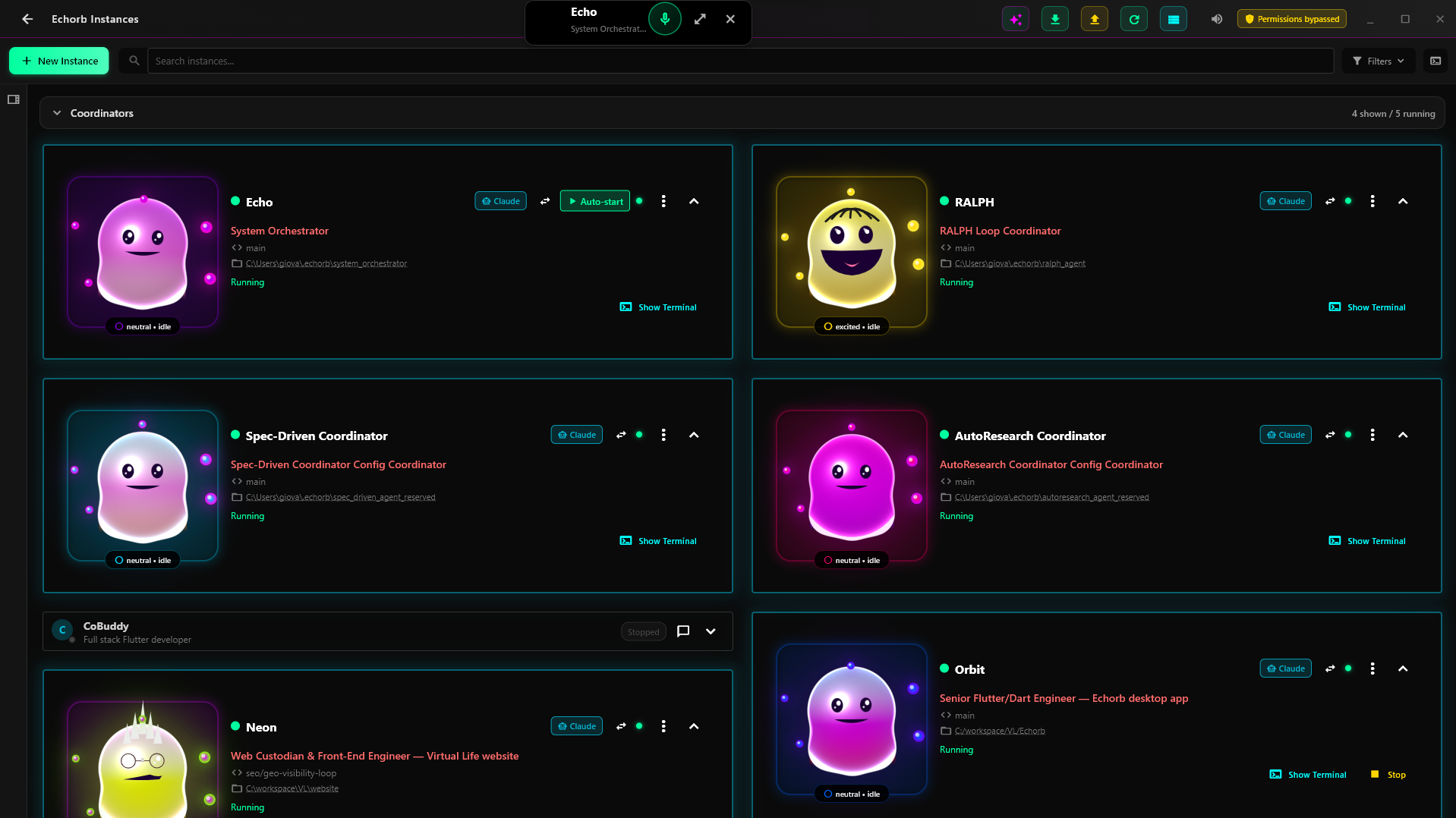
Orchestrate a whole team of AI coding agents from one place, with you in the loop. Now with five ways to point AI at your code, a private brain for every project, a voice, and permission approvals from your phone.

60-day free trial, no credit card. $10/month after. See what's new

Echorb, your AI coding orb

Release · v3.2.1 · out now

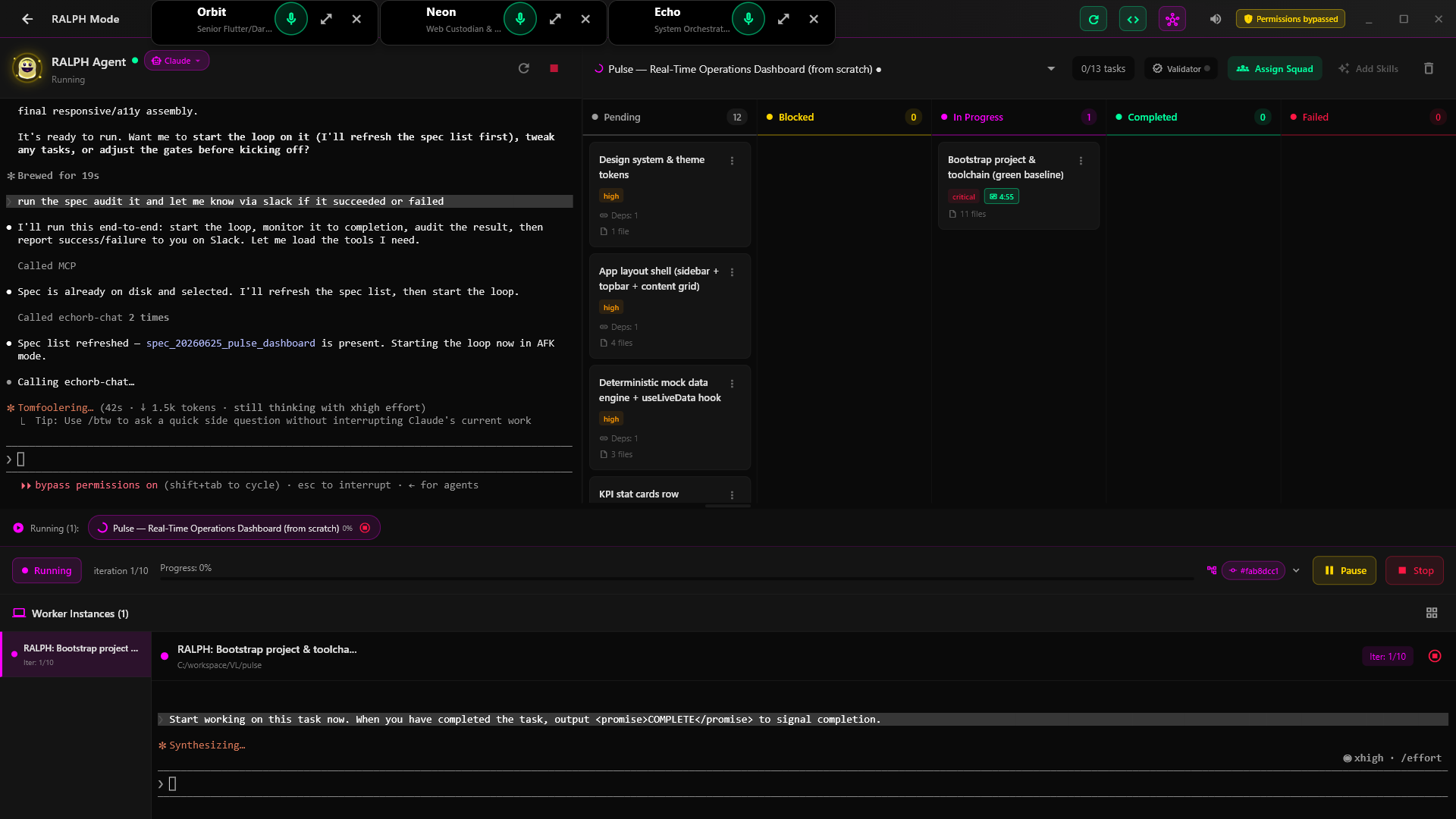
Graph Mode, a fifth loop mode that runs a job as a dependency graph of worker nodes, and a phone companion app that pairs with the desktop over your local network so you can approve permission prompts from your phone. Plus copyable code blocks in chat, bounded logging, and steadier instance startup. Fully backwards compatible.

Graph Mode is an early preview and ships switched off: turn it on per user under Settings, Agents, Loop Modes. Pair a phone under Settings, Mobile. Built-in providers remain Claude Code and Codex; OpenCode plugs in as a custom provider. The knowledge graph and voice remain optional, off by default, and stay on your machine. The AI coding agents connect to your chosen model provider to run. See Terms for details.

Five ways to point AI at your code

Alongside the original RALPH loop, four autonomous modes, each a different way to go from intent to verified work. Five modes, equal footing.

RALPH The original

The autonomous loop that drives a spec to done with fresh-context workers, start, pause, resume, stop.

Spec-Driven

Turn a one-line idea into a reviewed, approved plan, requirements, design and tasks, before a single line of code.

AutoResearch

Chase a measurable target: try an idea, measure, keep what improves the number, revert what doesn't.

Three-Agent

One agent builds; an independent reviewer grades each step against your criteria and sends it back until it passes.

Graph Mode

Describe the work and the repository to the Graph Coordinator and it proposes a graph of parallel worker nodes with edges between them, written to a config the app picks up and put on the board for you to approve. Then watch it run.

  • Level lanes, a live "active now" view, and a node inspector with per-node progress.
  • Retry or prune individual nodes without restarting the run.
  • Each node inherits the run's model or takes one you type in. A model Echorb can't verify warns rather than refusing to run.
  • Switched off by default. Turn it on per user under Settings, Agents, Loop Modes.
Echorb settings, Agents, Loop Modes: toggles for Spec-Driven, AutoResearch, Three-Agent Harness and Graph, plus default concurrency and auto-approve graph runs

Settings, Agents, Loop Modes: enable Graph, set default concurrency, auto-approve runs

Give your project a brain

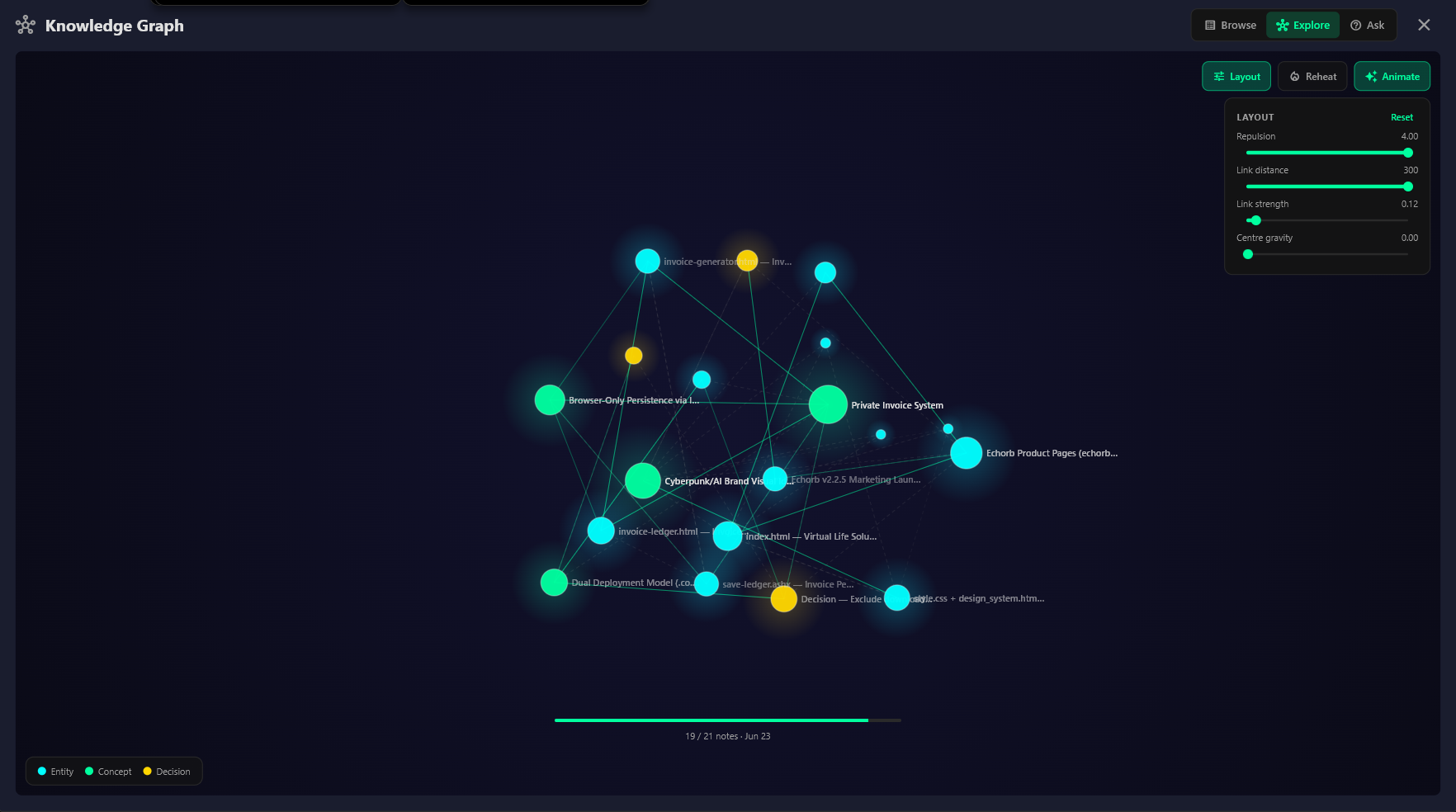
A private, per-project knowledge graph built from your codebase. Local and private, off by default.

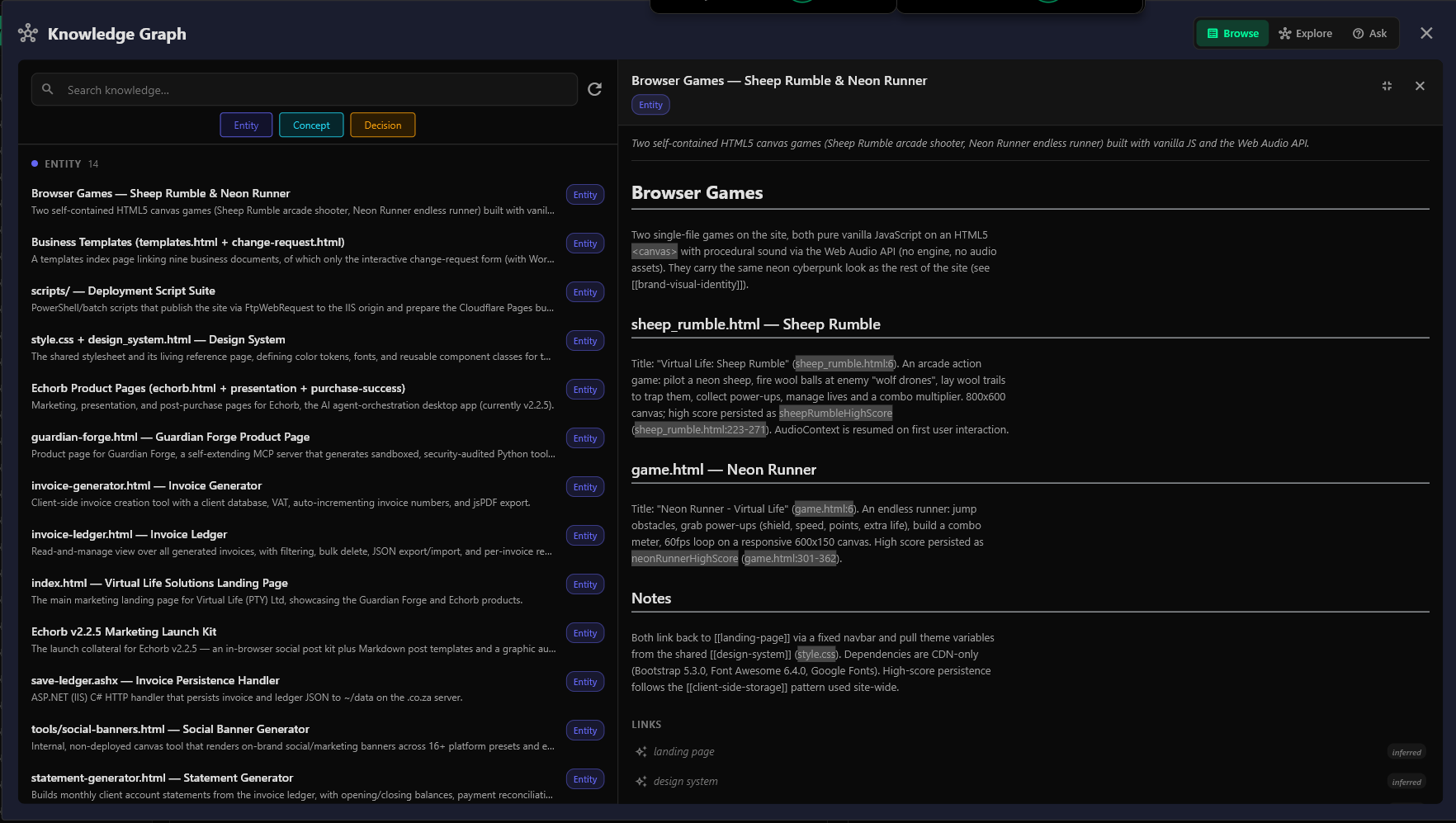
Echorb knowledge graph wiki browser with a page open and a citation

A cross-linked wiki of your codebase

Build a wiki. Echorb maps your project into linked pages, entities, concepts and decisions, you can browse and cross-reference.

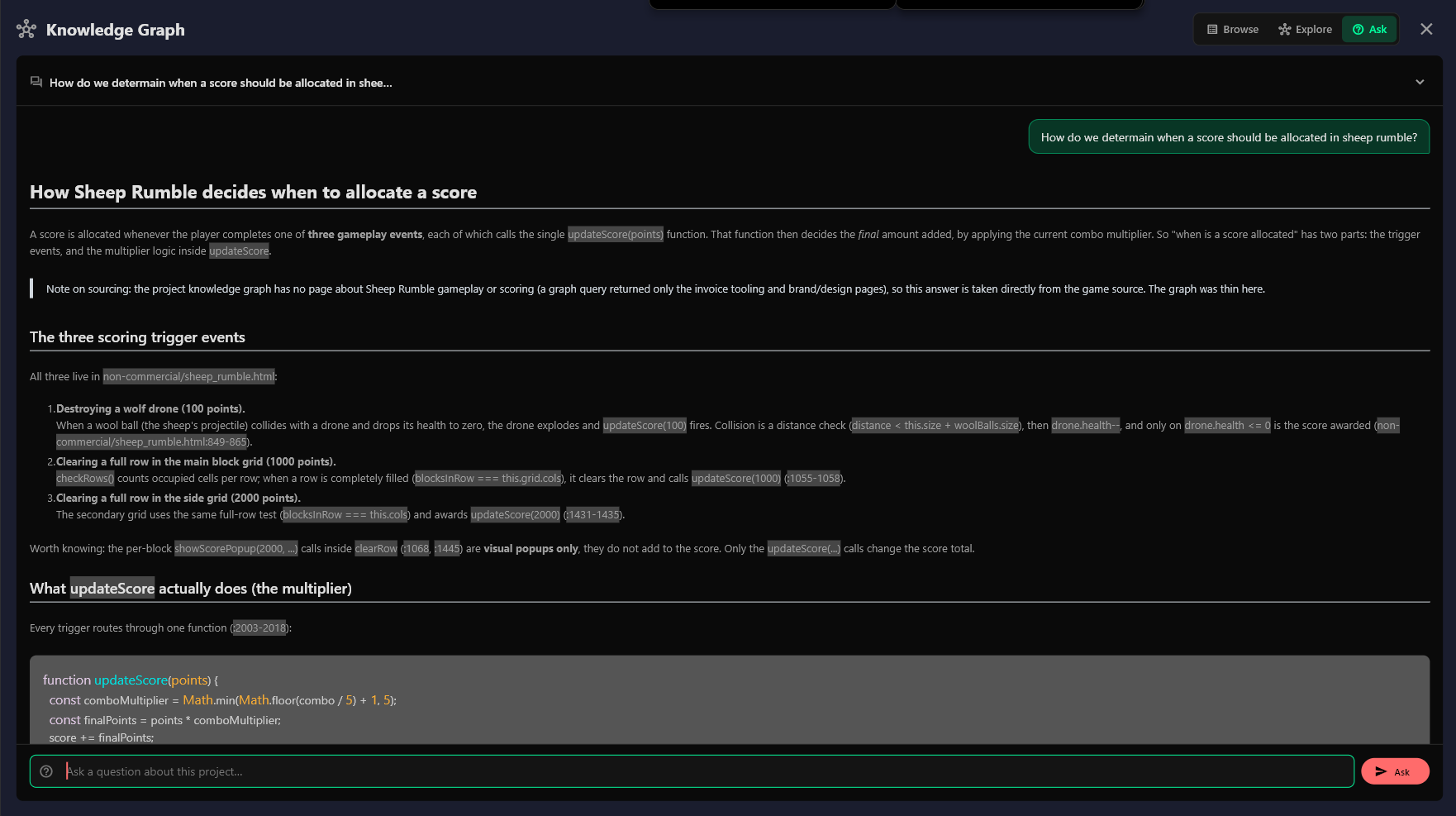
Echorb knowledge graph question and answer chat with a cited answer

Ask in plain English, answers cited to real files

Ask it anything. Pose a question in plain language and get an answer grounded in your actual files, every claim cited.

Approve from your phone

An Android companion app pairs with the desktop over your own network. See every instance and its state, and answer permission prompts from the couch, the kitchen, or the other office.

  • Pair in seconds: Settings, Mobile on the desktop, then scan the QR code or pick the machine from LAN device discovery.
  • Approve permission prompts from the phone: allow once, always allow, or deny with a comment that goes straight back to the agent.
  • Dashboard and servers at a glance: every instance, running or stopped, with its role.
  • Built for your local network: the phone talks to your desktop directly, no cloud relay. Away from home, join your own network first with Tailscale or your own VPN and it works the same way.

See it in action

A few more views from inside Echorb, plus two-way file sharing in chat and a broad production-readiness pass.

How it works

Three steps from install to launching your AI team.

01

Set up your harness

Install a supported coding agent (Claude Code or Codex), then point Echorb at it on first run. Other CLIs, such as OpenCode, plug in as custom providers. Add Node.js for MCP server support.

02

Install Echorb

Download for Windows, macOS or Linux. Your existing projects and work carry straight over.

03

Launch your AI team

Spin up agents, pick a loop mode, and coordinate everything from one dashboard, or approve from your phone.

Get Echorb 3.2.1

Three platforms, one release. 60-day free trial, no credit card. $10/month after.

Version 3.2.1 · Windows 10/11 (x64), macOS 14+, Linux with GTK 3 (x86_64). Fully backwards compatible, existing work keeps running.

Important: Git must be installed and functional in your terminal (PowerShell for Windows, Terminal for macOS / Linux). Download Git: Windows | macOS | Linux

Note: these are newly published apps, so your system may warn you on first launch. On Windows, choose "More info" then "Run anyway" at the SmartScreen prompt. The macOS build is signed and notarized, so it opens normally. On Linux, make the AppImage executable (chmod +x) before running.

System requirements

Cross-platform desktop. Bring your own coding agent.

Windows

System Requirements:

  • Windows 10 (1903+) / 11
  • 8GB RAM minimum
  • 10GB disk space
  • 64-bit processor
  • Git for Windows (PowerShell)

macOS

System Requirements:

  • macOS 14 (Sonoma) or later for voice
  • Apple Silicon or Intel processor
  • 8GB RAM minimum
  • Git (Terminal)
  • Mic + Accessibility perms on first voice use

Linux

System Requirements:

  • x86_64 AppImage, GTK 3 (modern distros)
  • 8GB RAM minimum
  • Git (Terminal)
  • PulseAudio (parecord, pactl) for voice
  • ffmpeg on PATH for capture

Frequently asked questions

An agentic loop is an AI coding agent that works toward a goal in repeated cycles, checking its own progress and continuing until the work is done. Echorb gives you five: RALPH runs a plan task by task; Three-Agent builds then has an independent reviewer grade the work; Spec-Driven turns an idea into an approved plan before coding; AutoResearch chases a measurable target, keeping only changes that help; and Graph (early preview) runs a job as a dependency graph of worker nodes that fan out, gate on results, and converge.

Yes. v3.2.1 is a drop-in upgrade. Your existing instances, teams, workflows, and subscription keep working. Graph Mode is switched off until you enable it in settings.

Yes. Voice and the knowledge graph are optional, off by default, and run entirely on your own machine, so your voice audio and your wiki never leave your computer. (The AI coding agents themselves connect to your chosen model provider to run.)

Echorb works with your existing Claude Max subscription via Claude Code, and also drives Codex out of the box. OpenCode and other CLIs plug in as custom providers for your own workflows. It doesn't replace your agentic harness. It amplifies it.

As many as your machine can handle. Most users run 3-10 in parallel for different aspects of a project; each harness uses RAM and CPU like any other terminal.

Yes! You can configure Git worktrees so each Echorb works on its own branch independently. When using worktrees, multiple instances can collaborate on the same project while maintaining separate working directories.

Try Echorb free for 60 days with every feature unlocked. No credit card required to start. After the trial, it's $10/month. Cancel any time.

Yes. Pair the Android companion app with the desktop under Settings, Mobile, by scanning a QR code or picking the machine from LAN device discovery. Once paired, the phone shows your instances and lets you allow once, always allow, or deny a permission prompt with a comment. The app is built for your local network. To use it away from home, connect to your own network first with Tailscale or your own VPN.